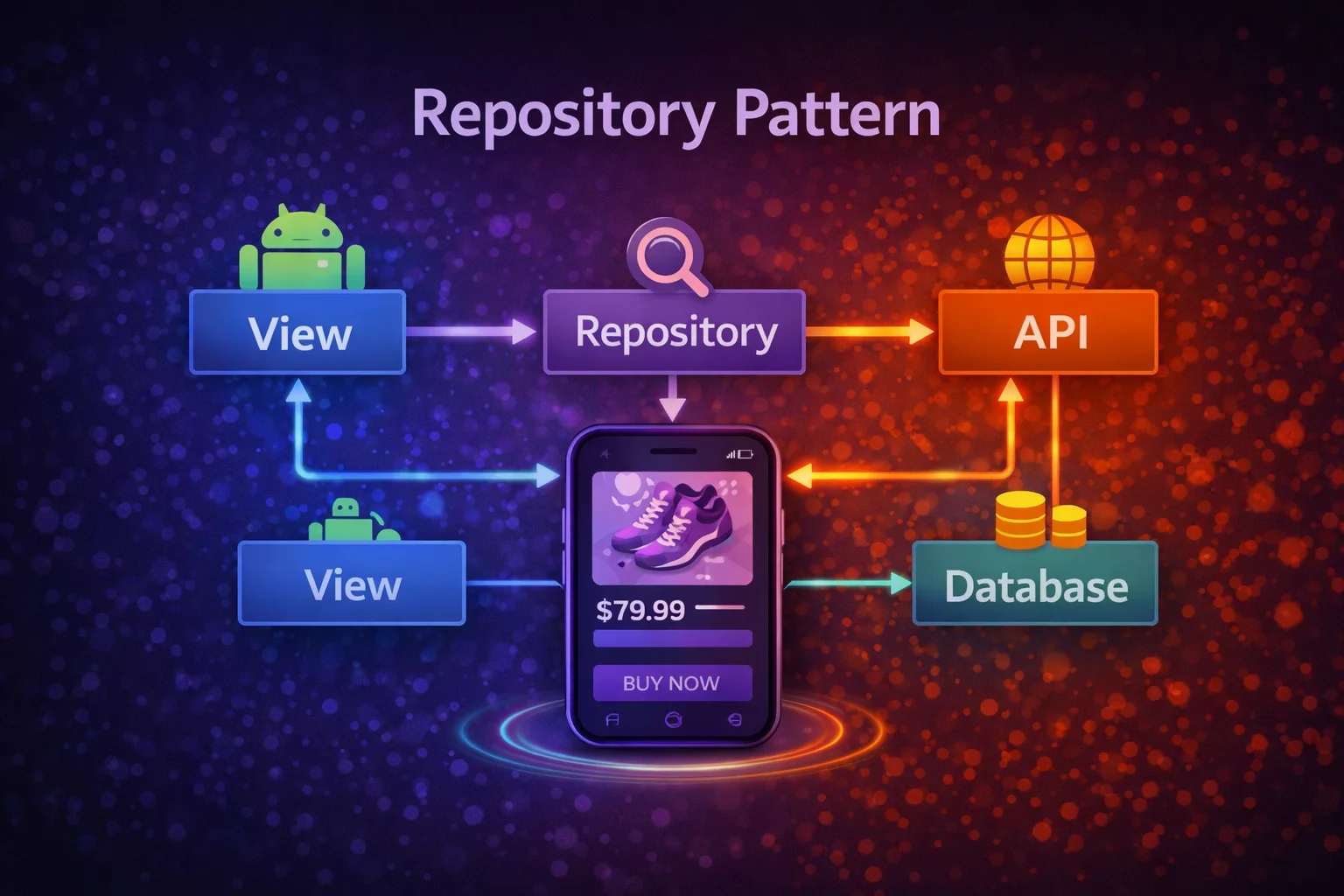
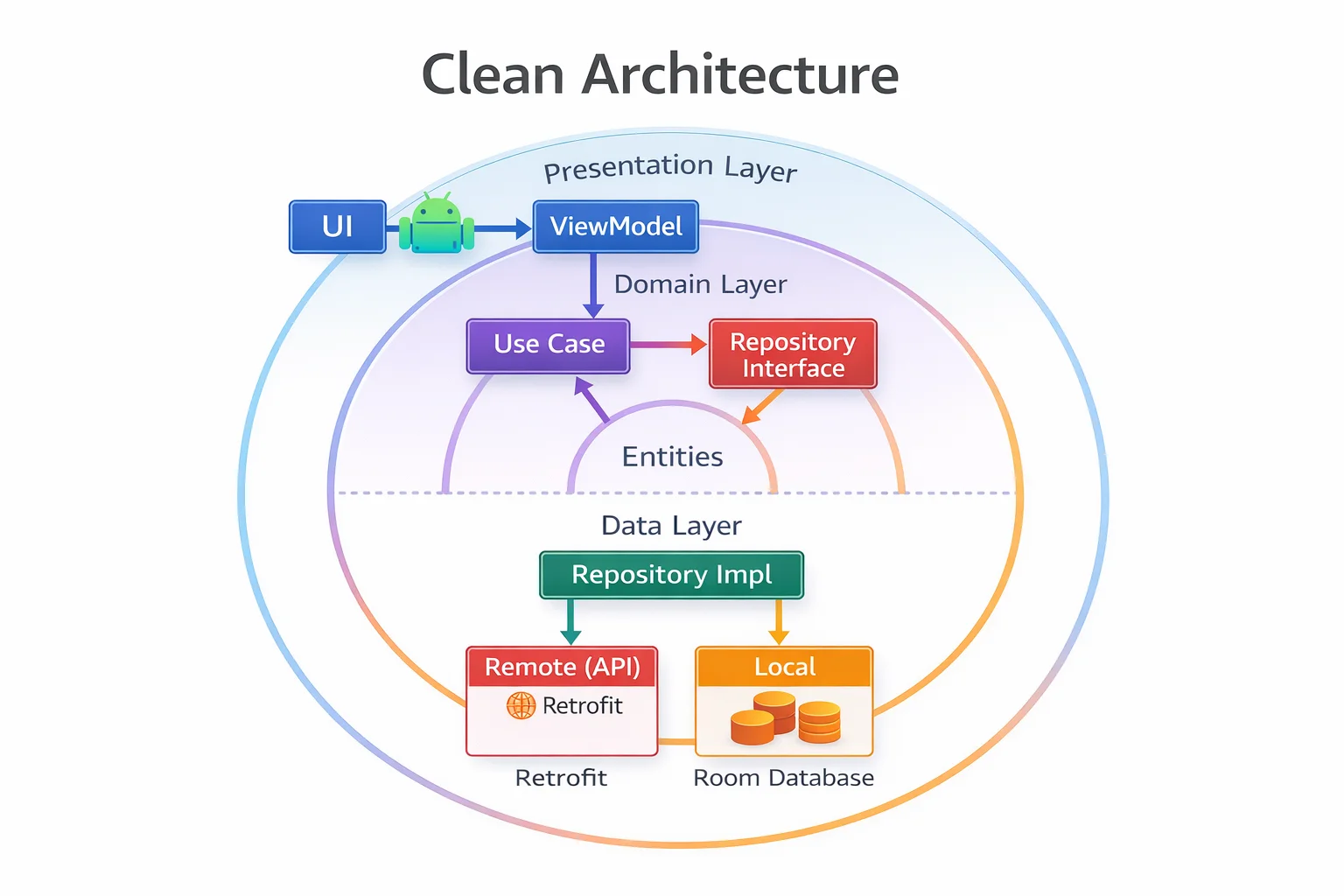
The Repository pattern is the backbone of Android’s data layer. It sits between your ViewModel and your data sources (API, database, preferences), providing a clean API that hides where the data comes from. The ViewModel doesn’t know if data came from the network, a local cache, or in-memory storage — it just asks the Repository. This guide covers the pattern deeply — single source of truth, caching strategies, offline-first, error handling, and how to structure repositories in real production apps.
What is the Repository Pattern?
// The Repository is a CLASS that COORDINATES multiple data sources
// and provides a single, clean API to the ViewModel

// WITHOUT Repository:
// ViewModel talks to API, Database, and Preferences DIRECTLY
//
//  ViewModel ──→ Retrofit API
//            ──→ Room Database
//            ──→ DataStore
//
// Problems:
// - ViewModel has too many responsibilities
// - No caching strategy — ViewModel manages cache logic
// - Can't swap data sources without changing ViewModel
// - Hard to test — need to mock API, database, AND preferences

// WITH Repository:
//
//  ViewModel ──→ Repository ──→ Remote Data Source (API)
//                           ──→ Local Data Source (Room)
//                           ──→ Preferences (DataStore)
//
// Benefits:
// ✅ ViewModel only talks to Repository — simple API
// ✅ Repository decides WHERE to get data (network, cache, both)
// ✅ Data sources are swappable (mock for tests, different API for staging)
// ✅ Single source of truth — one place manages data consistency
// ✅ Testable — test Repository with fake data sources
Single Source of Truth
The most important concept in the Repository pattern: one source owns the data, everything else reads from it.
// ═══ SINGLE SOURCE OF TRUTH PATTERN ═════════════════════════════════
//
//  Network API              Repository              Room Database
//  (remote)                 (coordinator)            (single source of truth)
//
//  GET /articles ←───────── refresh() ──────────→ INSERT articles
//                                                      │
//                                                      │ Flow emits
//                                                      ↓
//  ViewModel ←──────────── getArticlesFlow() ←──── SELECT * FROM articles
//                                                      │
//  UI ←────── collectAsStateWithLifecycle ←─────────────┘
//
// The DATABASE is the single source of truth — NOT the network
// Network response is written TO the database
// UI reads FROM the database
// When database changes → Flow emits → UI updates automatically
//
// Why the database, not the network?
// - Works offline (user sees cached data even without internet)
// - Consistent (one source, no conflicting states)
// - Reactive (Room Flow emits automatically when data changes)
// - Survives process death (database is persistent)
// Implementation:
class ArticleRepository @Inject constructor(
// @Inject is an ANNOTATION from javax.inject — marks constructor for Hilt
private val remoteDataSource: ArticleRemoteDataSource,
private val localDataSource: ArticleLocalDataSource
) {
// OBSERVE — always reads from local (single source of truth)
fun getArticlesFlow(): Flow<List<Article>> {
// Returns Flow — a cold reactive stream from Room
// Room's @Query that returns Flow automatically emits when data changes
return localDataSource.getArticlesFlow()
.map { entities -> entities.map { it.toDomain() } }
// map is an EXTENSION FUNCTION on Flow — transforms each emission
// toDomain() is an EXTENSION FUNCTION on ArticleEntity (mapper)
}
// REFRESH — fetches from network, writes to local
suspend fun refreshArticles() {
// suspend KEYWORD — this function can be called from a coroutine
val remoteArticles = remoteDataSource.getArticles()
// Network call → returns List<ArticleDto>
val entities = remoteArticles.map { it.toEntity() }
// toEntity() is an EXTENSION FUNCTION on ArticleDto (mapper)
localDataSource.insertArticles(entities)
// Write to database → Room Flow AUTOMATICALLY emits updated list
// ViewModel's collector receives the new data → UI updates
}
}Data Sources — The Building Blocks
Remote Data Source
// Wraps a single remote source (Retrofit API)
// Handles: network calls, DTO mapping, network-specific error handling

class ArticleRemoteDataSource @Inject constructor(
    private val api: ArticleApi,
    // ArticleApi is an INTERFACE — Retrofit generates the implementation
    private val ioDispatcher: CoroutineDispatcher
    // CoroutineDispatcher is an ABSTRACT CLASS from kotlinx.coroutines
) {
    suspend fun getArticles(): List<ArticleDto> {
        return withContext(ioDispatcher) {
            // withContext is a TOP-LEVEL SUSPEND FUNCTION — switches dispatcher
            api.getArticles()
        }
    }

    suspend fun getArticle(id: String): ArticleDto {
        return withContext(ioDispatcher) {
            api.getArticle(id)
        }
    }

    suspend fun searchArticles(query: String): List<ArticleDto> {
        return withContext(ioDispatcher) {
            api.search(query)
        }
    }
}

// Note: Retrofit suspend functions are main-safe by default
// (they switch to a background thread internally)
// But wrapping in withContext(IO) is a common defensive pattern
// Some teams skip it and let Retrofit handle threading
Local Data Source
// Wraps a single local source (Room Database)
// Handles: database operations, entity mapping

class ArticleLocalDataSource @Inject constructor(
    private val dao: ArticleDao
    // ArticleDao is an INTERFACE annotated @Dao — Room generates implementation
) {
    fun getArticlesFlow(): Flow<List<ArticleEntity>> {
        // Returns Flow — Room emits whenever the table changes
        return dao.getAllArticles()
    }

    fun getArticleFlow(id: String): Flow<ArticleEntity?> {
        return dao.getArticleById(id)
    }

    suspend fun insertArticles(articles: List<ArticleEntity>) {
        dao.insertAll(articles)
    }

    suspend fun deleteArticle(id: String) {
        dao.deleteById(id)
    }

    suspend fun clearAll() {
        dao.deleteAll()
    }
}

// Room DAO
@Dao
// @Dao is an ANNOTATION from Room
interface ArticleDao {

    @Query("SELECT * FROM articles ORDER BY published_at DESC")
    fun getAllArticles(): Flow<List<ArticleEntity>>
    // Returning Flow makes this REACTIVE — emits on every database change

    @Query("SELECT * FROM articles WHERE id = :id")
    fun getArticleById(id: String): Flow<ArticleEntity?>

    @Insert(onConflict = OnConflictStrategy.REPLACE)
    // @Insert is an ANNOTATION from Room
    // OnConflictStrategy is an ENUM — REPLACE, IGNORE, ABORT
    suspend fun insertAll(articles: List<ArticleEntity>)

    @Query("DELETE FROM articles WHERE id = :id")
    suspend fun deleteById(id: String)

    @Query("DELETE FROM articles")
    suspend fun deleteAll()
}
Preferences Data Source
// Wraps DataStore for user preferences

class PreferencesDataSource @Inject constructor(
    private val dataStore: DataStore<Preferences>
    // DataStore is an INTERFACE from androidx.datastore
    // Preferences is a CLASS that holds key-value pairs
) {
    val sortOrderFlow: Flow<SortOrder> = dataStore.data
        // data is a PROPERTY on DataStore — returns Flow<Preferences>
        .map { preferences ->
            val value = preferences[SORT_ORDER_KEY] ?: SortOrder.NEWEST.name
            SortOrder.valueOf(value)
        }
        .catch { emit(SortOrder.NEWEST) }
        // catch is an EXTENSION FUNCTION on Flow — handles read errors

    suspend fun setSortOrder(sortOrder: SortOrder) {
        dataStore.edit { preferences ->
            // edit is a SUSPEND EXTENSION FUNCTION on DataStore
            preferences[SORT_ORDER_KEY] = sortOrder.name
        }
    }

    companion object {
        private val SORT_ORDER_KEY = stringPreferencesKey("sort_order")
        // stringPreferencesKey() is a TOP-LEVEL FUNCTION — creates a typed key
    }
}

enum class SortOrder { NEWEST, OLDEST, POPULAR }
Layer Models and Mappers
// Each layer has its OWN model — prevents coupling between layers
//
// DTO (Data Transfer Object) — network model
//   Matches the API response JSON
//   Has Gson/Moshi annotations
//   Lives in: data/remote/dto/
//
// Entity — database model
//   Matches the Room table schema
//   Has Room annotations (@Entity, @PrimaryKey)
//   Lives in: data/local/entity/
//
// Domain Model — business logic model
//   Clean, no framework annotations
//   What the rest of the app works with
//   Lives in: domain/model/

// ═══ WHY separate models? ═══════════════════════════════════════════
//
// API returns:               Database stores:          App uses:
// { "article_id": "123",    @Entity                    data class Article(
//   "article_title": "Hi",  id: String                   id: String,
//   "pub_date": 170000,     title: String                title: String,
//   "img": "url" }          publishedAt: Long            publishedAt: Long,
//                            imageUrl: String?            imageUrl: String?,
//                                                         formattedDate: String,
//                                                         isBookmarked: Boolean)
//
// If the API renames "article_title" to "title":
// → Only DTO changes, Entity and Domain are unaffected
// If you add a computed property (formattedDate):
// → Only Domain model has it, not DTO or Entity
// If you switch from Room to SQLDelight:
// → Only Entity changes, Domain and DTO are unaffected
// Mappers — extension functions that convert between layers
// DTO → Entity (network response → database)
fun ArticleDto.toEntity(): ArticleEntity = ArticleEntity(
id = articleId, // API uses "articleId", Entity uses "id"
title = articleTitle, // API uses "articleTitle", Entity uses "title"
author = authorName,
publishedAt = pubDate,
imageUrl = img
)
// toEntity() is an EXTENSION FUNCTION on ArticleDto
// Entity → Domain (database → app logic)
fun ArticleEntity.toDomain(): Article = Article(
id = id,
title = title,
author = author,
publishedAt = publishedAt,
imageUrl = imageUrl,
isBookmarked = false // enriched later from bookmarks table
)
// toDomain() is an EXTENSION FUNCTION on ArticleEntity
// Domain → Entity (app logic → database, for local-only data)
fun Article.toEntity(): ArticleEntity = ArticleEntity(
id = id,
title = title,
author = author,
publishedAt = publishedAt,
imageUrl = imageUrl
)
// Why extension functions for mappers?
// ✅ Clean — articleDto.toEntity() reads naturally
// ✅ Discoverable — IDE suggests .toEntity() on ArticleDto
// ✅ Testable — pure functions, easy to unit test
// ✅ No mapper class needed — just functionsCaching Strategies
// Strategy 1: NETWORK FIRST — always fetch, cache as backup
// Best for: frequently changing data (social feed, news, stock prices)

suspend fun refreshArticles() {
    try {
        val remote = remoteDataSource.getArticles()
        localDataSource.insertArticles(remote.map { it.toEntity() })
    } catch (e: Exception) {
        // Network failed — cached data is already in the database
        // Room Flow still emits the last cached data → UI shows stale but usable data
    }
}

// Strategy 2: CACHE FIRST — read local, refresh in background
// Best for: data that doesn't change often (user profile, settings, categories)

fun getArticlesFlow(): Flow<List<Article>> = flow {
    // Emit cached data immediately
    val cached = localDataSource.getArticlesOnce()
    if (cached.isNotEmpty()) {
        emit(cached.map { it.toDomain() })
    }

    // Then refresh from network in background
    try {
        val remote = remoteDataSource.getArticles()
        localDataSource.insertArticles(remote.map { it.toEntity() })
        val updated = localDataSource.getArticlesOnce()
        emit(updated.map { it.toDomain() })
    } catch (e: Exception) {
        if (cached.isEmpty()) throw e   // no cache AND no network → error
    }
}

// Strategy 3: CACHE WITH EXPIRY — use cache if fresh, fetch if stale
// Best for: data that changes periodically (weather, exchange rates)

suspend fun getArticles(): List<Article> {
    val lastFetch = preferencesDataSource.getLastFetchTimestamp()
    val cacheExpiry = 30 * 60 * 1000L   // 30 minutes

    return if (System.currentTimeMillis() - lastFetch < cacheExpiry) {
        // Cache is fresh — use it
        localDataSource.getArticlesOnce().map { it.toDomain() }
    } else {
        // Cache is stale — refresh
        val remote = remoteDataSource.getArticles()
        localDataSource.insertArticles(remote.map { it.toEntity() })
        preferencesDataSource.setLastFetchTimestamp(System.currentTimeMillis())
        localDataSource.getArticlesOnce().map { it.toDomain() }
    }
}

// Strategy 4: OFFLINE-FIRST with Room Flow (RECOMMENDED)
// Best for: most Android apps — works offline, reactive updates

fun getArticlesFlow(): Flow<List<Article>> {
    return localDataSource.getArticlesFlow()
        .map { entities -> entities.map { it.toDomain() } }
    // Room Flow emits cached data IMMEDIATELY
    // Then when refresh() writes new data → Room Flow emits AGAIN automatically
}

suspend fun refreshArticles() {
    val remote = remoteDataSource.getArticles()
    localDataSource.insertArticles(remote.map { it.toEntity() })
    // Room Flow picks up the change and emits to all collectors
}
Error Handling in Repository
// Option 1: Result wrapper — explicit success/failure

sealed interface Result<out T> {
    // sealed interface — restricted hierarchy for exhaustive when
    data class Success<T>(val data: T) : Result<T>
    data class Error(val exception: Throwable) : Result<Nothing>
}

class ArticleRepository @Inject constructor(
    private val remoteDataSource: ArticleRemoteDataSource,
    private val localDataSource: ArticleLocalDataSource
) {
    suspend fun refreshArticles(): Result<Unit> {
        return try {
            val remote = remoteDataSource.getArticles()
            localDataSource.insertArticles(remote.map { it.toEntity() })
            Result.Success(Unit)
        } catch (e: CancellationException) {
            throw e   // always re-throw CancellationException!
        } catch (e: Exception) {
            Result.Error(e)
        }
    }
}

// ViewModel handles the result:
fun refresh() {
    viewModelScope.launch {
        when (val result = repository.refreshArticles()) {
            is Result.Success -> { /* Room Flow handles UI update */ }
            is Result.Error -> _events.emit(UiEvent.ShowSnackbar(result.exception.message ?: "Error"))
        }
    }
}


// Option 2: Let exceptions propagate — ViewModel catches them

class ArticleRepository @Inject constructor(...) {
    suspend fun refreshArticles() {
        // Throws on failure — let caller handle it
        val remote = remoteDataSource.getArticles()
        localDataSource.insertArticles(remote.map { it.toEntity() })
    }
}

// ViewModel:
fun refresh() {
    viewModelScope.launch {
        try {
            repository.refreshArticles()
        } catch (e: CancellationException) { throw e }
        catch (e: Exception) {
            _events.emit(UiEvent.ShowSnackbar("Refresh failed"))
        }
    }
}

// Which approach?
// Result wrapper → when Repository methods are called directly and caller needs to decide
// Exception propagation → when using Flow pipelines (catch handles it)
// Both are valid — pick one and be consistent in your project
Complete Repository — Production Example
class ArticleRepository @Inject constructor(
    private val remoteDataSource: ArticleRemoteDataSource,
    private val localDataSource: ArticleLocalDataSource,
    private val preferencesDataSource: PreferencesDataSource
) {
    // ═══ OBSERVE (reactive) ═════════════════════════════════════════

    // All articles — sorted by user preference
    fun getArticlesFlow(): Flow<List<Article>> {
        return combine(
            // combine is a TOP-LEVEL FUNCTION from kotlinx.coroutines.flow
            // Merges multiple Flows — emits when ANY source emits
            localDataSource.getArticlesFlow(),
            preferencesDataSource.sortOrderFlow
        ) { entities, sortOrder ->
            val articles = entities.map { it.toDomain() }
            when (sortOrder) {
                SortOrder.NEWEST -> articles.sortedByDescending { it.publishedAt }
                SortOrder.OLDEST -> articles.sortedBy { it.publishedAt }
                SortOrder.POPULAR -> articles.sortedByDescending { it.viewCount }
            }
        }
    }

    // Single article by ID
    fun getArticleFlow(id: String): Flow<Article?> {
        return localDataSource.getArticleFlow(id)
            .map { entity -> entity?.toDomain() }
    }

    // Search articles
    fun searchArticlesFlow(query: String): Flow<List<Article>> {
        return localDataSource.searchFlow(query)
            .map { entities -> entities.map { it.toDomain() } }
    }

    // ═══ WRITE (imperative) ═════════════════════════════════════════

    // Refresh from network
    suspend fun refreshArticles() {
        val remote = remoteDataSource.getArticles()
        localDataSource.insertArticles(remote.map { it.toEntity() })
    }

    // Toggle bookmark
    suspend fun toggleBookmark(articleId: String) {
        localDataSource.toggleBookmark(articleId)
    }

    // Delete article
    suspend fun deleteArticle(articleId: String) {
        localDataSource.deleteArticle(articleId)
        // Optionally: remoteDataSource.deleteArticle(articleId)
    }

    // Change sort order
    suspend fun setSortOrder(sortOrder: SortOrder) {
        preferencesDataSource.setSortOrder(sortOrder)
        // preferencesDataSource.sortOrderFlow emits → combine re-evaluates
        // → getArticlesFlow() emits re-sorted list → UI updates
    }
}
Repository in ViewModel
@HiltViewModel
class ArticleViewModel @Inject constructor(
    private val repository: ArticleRepository
) : ViewModel() {

    // Reactive pipeline: Repository Flow → StateFlow for UI
    val articles: StateFlow<List<Article>> = repository.getArticlesFlow()
        .stateIn(
            scope = viewModelScope,
            started = SharingStarted.WhileSubscribed(5000),
            initialValue = emptyList()
        )
    // stateIn is an EXTENSION FUNCTION on Flow → converts cold to hot StateFlow

    private val _isRefreshing = MutableStateFlow(false)
    val isRefreshing: StateFlow<Boolean> = _isRefreshing.asStateFlow()

    private val _events = MutableSharedFlow<UiEvent>()
    val events: SharedFlow<UiEvent> = _events.asSharedFlow()

    init {
        refresh()   // initial data load
    }

    fun refresh() {
        viewModelScope.launch {
            _isRefreshing.value = true
            try {
                repository.refreshArticles()
                // Room Flow automatically emits updated data
                // stateIn picks it up → articles StateFlow updates → UI recomposes
            } catch (e: CancellationException) { throw e }
            catch (e: Exception) {
                _events.emit(UiEvent.ShowSnackbar("Refresh failed: ${e.message}"))
            } finally {
                _isRefreshing.value = false
            }
        }
    }

    fun onSortOrderChanged(sortOrder: SortOrder) {
        viewModelScope.launch {
            repository.setSortOrder(sortOrder)
            // Preferences Flow emits → combine in Repository re-sorts
            // → articles StateFlow updates → UI shows re-sorted list
            // All automatic — no manual re-fetch needed!
        }
    }

    fun onBookmarkToggled(articleId: String) {
        viewModelScope.launch {
            repository.toggleBookmark(articleId)
        }
    }
}
Testing Repositories
// Repositories are easy to test with FAKE data sources

// Fake remote data source
class FakeArticleRemoteDataSource : ArticleRemoteDataSource {
    var articlesToReturn = listOf<ArticleDto>()
    var shouldThrow = false

    override suspend fun getArticles(): List<ArticleDto> {
        if (shouldThrow) throw IOException("Network error")
        return articlesToReturn
    }
}

// Fake local data source
class FakeArticleLocalDataSource : ArticleLocalDataSource {
    private val articles = MutableStateFlow<List<ArticleEntity>>(emptyList())

    override fun getArticlesFlow(): Flow<List<ArticleEntity>> = articles

    override suspend fun insertArticles(entities: List<ArticleEntity>) {
        articles.value = entities
    }
}

// Test
class ArticleRepositoryTest {
    private val remoteDataSource = FakeArticleRemoteDataSource()
    private val localDataSource = FakeArticleLocalDataSource()
    private val repository = ArticleRepository(remoteDataSource, localDataSource)

    @Test
    fun `refresh writes remote data to local`() = runTest {
        // runTest is a TOP-LEVEL FUNCTION from kotlinx-coroutines-test
        remoteDataSource.articlesToReturn = listOf(sampleDto)

        repository.refreshArticles()

        val local = localDataSource.getArticlesFlow().first()
        // first() is an EXTENSION FUNCTION on Flow — collects first emission
        assertEquals(1, local.size)
        assertEquals(sampleDto.articleId, local[0].id)
    }

    @Test
    fun `refresh failure doesn't clear cache`() = runTest {
        localDataSource.insertArticles(listOf(sampleEntity))
        remoteDataSource.shouldThrow = true

        try { repository.refreshArticles() }
        catch (e: Exception) { /* expected */ }

        val local = localDataSource.getArticlesFlow().first()
        assertEquals(1, local.size)   // cache is still intact!
    }
}
Common Mistakes to Avoid
Mistake 1: Repository holding state
// ❌ Repository caches data in a variable — becomes stale, hard to test
class ArticleRepository {
    private var cachedArticles: List<Article>? = null   // ❌ state in Repository

    suspend fun getArticles(): List<Article> {
        if (cachedArticles != null) return cachedArticles!!
        val remote = api.getArticles()
        cachedArticles = remote
        return remote
    }
}

// ✅ Database IS the cache — Repository is stateless
class ArticleRepository {
    fun getArticlesFlow(): Flow<List<Article>> = dao.getArticles().map { /* ... */ }
    suspend fun refresh() { dao.insertAll(api.getArticles()) }
}
Mistake 2: Returning DTO or Entity from Repository
// ❌ ViewModel receives network/database model — coupled to data layer
class ArticleRepository {
    fun getArticles(): Flow<List<ArticleEntity>> = dao.getArticles()
    // ViewModel now depends on Room's ArticleEntity!
}

// ✅ Return domain model — clean separation
class ArticleRepository {
    fun getArticles(): Flow<List<Article>> = dao.getArticles()
        .map { entities -> entities.map { it.toDomain() } }
}
Mistake 3: Multiple sources of truth
// ❌ Sometimes reads from API, sometimes from database — inconsistent
class ArticleRepository {
    suspend fun getArticles(): List<Article> {
        return if (isOnline()) api.getArticles() else dao.getArticles()
        // Two sources — can show different data!
    }
}

// ✅ Single source: always read from database, network refreshes it
class ArticleRepository {
    fun getArticlesFlow(): Flow<List<Article>> = dao.getArticlesFlow().map { ... }
    suspend fun refresh() { dao.insertAll(api.getArticles()) }
}
Mistake 4: Swallowing CancellationException
// ❌ Catches ALL exceptions including CancellationException
suspend fun refreshArticles(): Result<Unit> = try {
    val data = api.getArticles()
    dao.insertAll(data)
    Result.Success(Unit)
} catch (e: Exception) {   // catches CancellationException too!
    Result.Error(e)         // breaks structured concurrency!
}

// ✅ Always re-throw CancellationException
suspend fun refreshArticles(): Result<Unit> = try {
    val data = api.getArticles()
    dao.insertAll(data)
    Result.Success(Unit)
} catch (e: CancellationException) {
    throw e   // ALWAYS re-throw
} catch (e: Exception) {
    Result.Error(e)
}
Mistake 5: One giant Repository for everything
// ❌ God Repository — knows about articles, users, settings, analytics
class AppRepository {
    fun getArticles() = ...
    fun getUser() = ...
    fun getSettings() = ...
    fun logEvent() = ...
    // Grows endlessly, impossible to test, violates single responsibility
}

// ✅ One Repository per domain concept
class ArticleRepository { fun getArticlesFlow(): Flow<...> }
class UserRepository { fun getUserFlow(): Flow<...> }
class SettingsRepository { fun getSortOrder(): Flow<...> }
// Each is focused, testable, and reusable
Summary
- The Repository pattern coordinates multiple data sources behind a clean API — ViewModel doesn’t know where data comes from
- Single source of truth: the database (Room) is the source, network refreshes update it, UI reads from it via Flow
- Repository uses Data Sources: Remote (Retrofit), Local (Room), Preferences (DataStore) — each wraps one external source
- Use separate models per layer: DTO (network), Entity (database), Domain (business logic) with mapper extension functions
- Caching strategies: network-first, cache-first, cache-with-expiry, offline-first (recommended)
- Repository should be stateless — the database is the cache, not an in-memory variable
- Return domain models from Repository, never DTOs or Entities — keeps layers decoupled
- Use
combine()(top-level function) to merge multiple Flows (articles + sort order → sorted articles) - Handle errors with Result wrapper or exception propagation — pick one approach and be consistent
- Always re-throw CancellationException in catch blocks — breaking structured concurrency causes subtle bugs
- One Repository per domain concept (ArticleRepository, UserRepository) — not one giant AppRepository
- Test with Fake data sources — Repository is easy to test because it depends on interfaces
The Repository pattern isn’t complicated — it’s a coordinator between data sources with the database as the single source of truth. The key insight is that the UI should never care where data comes from. It observes a Room Flow, and the Repository makes sure that Flow always has the right data — whether it came from the network, a cache, or an offline fallback. Get this right, and your app works reliably online, offline, and everything in between.
Happy coding!
Comments (0)