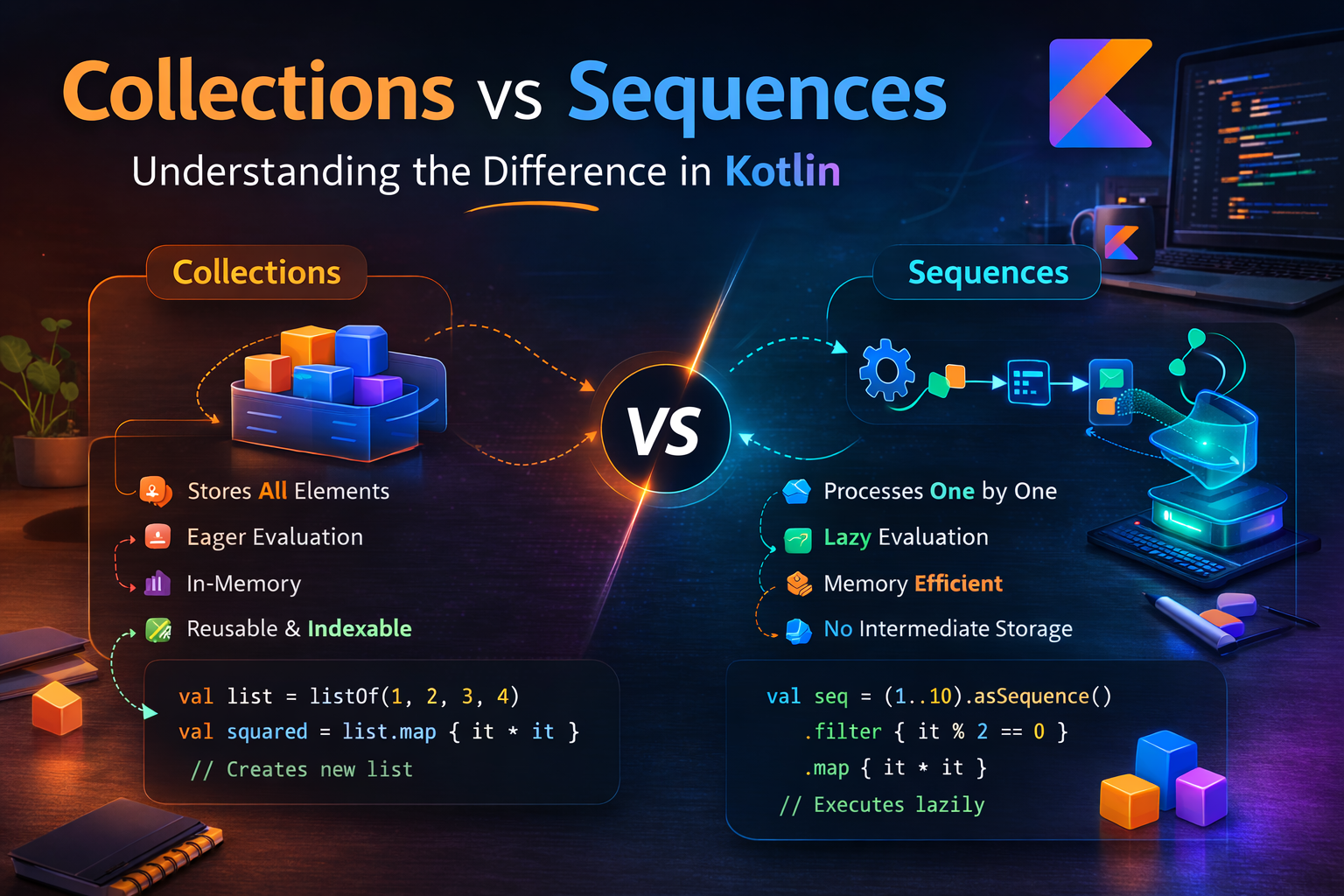
You now know what collections and sequences are. The real skill is knowing which one to reach for in a given situation. Using a sequence where a collection would be faster — or a collection where a sequence would save memory — both lead to worse code. This guide gives you a clear, practical decision framework backed by real Android scenarios.
The Core Difference in One Sentence
Collections are eager — every operation processes all elements immediately and returns a new collection.
Sequences are lazy — operations build a pipeline that only runs when a terminal operation requests results.
val numbers = listOf(1, 2, 3, 4, 5, 6, 7, 8, 9, 10)

// Collection — two full passes, two intermediate lists created
val collectionResult = numbers
    .map { it * 2 }       // pass 1: [2,4,6,8,10,12,14,16,18,20] — all 10
    .filter { it > 10 }   // pass 2: [12,14,16,18,20] — all 10 again
// Result: [12, 14, 16, 18, 20]

// Sequence — one pass, no intermediate lists, stops early if possible
val sequenceResult = numbers.asSequence()
    .map { it * 2 }       // no work yet
    .filter { it > 10 }   // no work yet
    .toList()             // now processes — one element at a time
// Result: [12, 14, 16, 18, 20]
When to Use Collections
Small to medium datasets
Sequences have overhead — lambda dispatch, iterator wrappers, pipeline setup. For small lists this overhead costs more than the savings:
// ✅ Collection — fast for small lists, no unnecessary overhead
val topCategories = articles
    .groupBy { it.category }
    .mapValues { (_, list) -> list.size }
    .entries
    .sortedByDescending { it.value }
    .take(5)
    .map { it.key }

// ❌ Sequence here — adds overhead, no benefit for ~50 articles
val topCategories = articles.asSequence()
    .groupBy { it.category }   // groupBy is a terminal op on sequences anyway
    ...
When you need the result multiple times
// ✅ Collection — compute once, use many times
val publishedArticles = articles.filter { it.isPublished }

val count = publishedArticles.size           // use 1
val titles = publishedArticles.map { it.title }  // use 2
val latest = publishedArticles.maxByOrNull { it.publishedAt }  // use 3

// ❌ Sequence — re-runs the pipeline each time a terminal op is called
val publishedSeq = articles.asSequence().filter { it.isPublished }
val count = publishedSeq.count()       // runs pipeline once
val titles = publishedSeq.map { it.title }.toList()  // runs pipeline again
val latest = publishedSeq.maxByOrNull { it.publishedAt }  // runs pipeline again
When you need groupBy, associate, or partition
These operations return a Map or Pair — they're terminal by nature and consume the entire collection anyway. The lazy benefit of sequences is lost:
// ✅ Collection — groupBy consumes everything regardless, no sequence benefit
val byCategory = articles.groupBy { it.category }
val (published, drafts) = articles.partition { it.isPublished }
val articleMap = articles.associateBy { it.id }

// ❌ Sequence adds overhead here with no benefit
val byCategory = articles.asSequence().groupBy { it.category }  // still processes all
When order of intermediate results matters for debugging
// ✅ Collection — each step produces a concrete inspectable list
val step1 = articles.filter { it.isPublished }
println("After filter: ${step1.size}")   // easy to inspect intermediate state

val step2 = step1.map { it.title }
println("After map: $step2")

// Sequences don't produce intermediate results — harder to debug step by step
When to Use Sequences
Large collections with early termination
The biggest win for sequences — when you only need a few results from a large dataset:
// ✅ Sequence — 100,000 articles, only need first 10 matches
fun getTopUnreadArticles(articles: List<Article>, readIds: Set<String>): List<Article> {
    return articles.asSequence()
        .filter { it.id !in readIds }
        .filter { it.isPublished }
        .sortedByDescending { it.viewCount }
        .take(10)           // stops after 10 found — never processes the rest
        .toList()
}

// ❌ Collection — creates two intermediate lists of 100,000 each
fun getTopUnreadArticles(articles: List<Article>, readIds: Set<String>): List<Article> {
    return articles
        .filter { it.id !in readIds }       // 100,000 → maybe 80,000
        .filter { it.isPublished }           // 80,000 → maybe 70,000
        .sortedByDescending { it.viewCount } // sorts all 70,000
        .take(10)                            // finally takes 10
}
Many chained operations on large data
Each additional operation on a collection creates another full intermediate list. Sequences create none:
// ✅ Sequence — 5 operations, 0 intermediate lists
val result = allArticles.asSequence()
    .filter { it.isPublished }
    .filter { !it.isDeleted }
    .filter { it.category in selectedCategories }
    .map { it.toDisplayModel() }
    .sortedByDescending { it.date }
    .toList()

// ❌ Collection — 5 operations, 4 intermediate lists in memory
val result = allArticles
    .filter { it.isPublished }              // intermediate list 1
    .filter { !it.isDeleted }               // intermediate list 2
    .filter { it.category in selectedCategories }  // intermediate list 3
    .map { it.toDisplayModel() }            // intermediate list 4
    .sortedByDescending { it.date }         // final list
Infinite or very large streams
// ✅ Sequence — infinite stream, only compute what's needed
val firstPrimesOver100 = generateSequence(2) { it + 1 }
    .filter { n -> (2 until n).none { n % it == 0 } }
    .filter { it > 100 }
    .take(5)
    .toList()
// [101, 103, 107, 109, 113]

// Cannot do this with a collection — you can't create an "infinite list"
File or stream processing
// ✅ Sequence — process 1GB log file without loading it into memory
fun countCriticalErrors(logFile: File): Int {
    return logFile.bufferedReader()
        .lineSequence()
        .filter { "CRITICAL" in it }
        .count()
}
Direct Comparison — Same Task, Both Approaches
Scenario 1: Get first 5 published articles from large list
val articles = List(50_000) { Article(id = "$it", isPublished = it % 3 == 0) }

// Collection — processes all 50,000 before taking 5
val result1 = articles
    .filter { it.isPublished }   // ~16,666 items processed, intermediate list created
    .take(5)                     // takes from the 16,666

// Sequence — stops after finding 5 matches (~15 items processed)
val result2 = articles.asSequence()
    .filter { it.isPublished }
    .take(5)
    .toList()

// Winner: Sequence — drastically fewer operations
Scenario 2: Group 50 articles by category
val articles = listOf(/* 50 articles */)

// Collection — direct, no overhead, result cached
val byCategory = articles.groupBy { it.category }

// Sequence — adds overhead, groupBy still processes everything
val byCategory = articles.asSequence().groupBy { it.category }

// Winner: Collection — groupBy processes all anyway, sequence overhead is wasted
Scenario 3: Transform all 1,000 articles to display models
val articles = listOf(/* 1,000 articles */)

// Collection — single map operation, simple and fast
val displayModels = articles.map { it.toDisplayModel() }

// Sequence — adds overhead, no early termination possible here
val displayModels = articles.asSequence().map { it.toDisplayModel() }.toList()

// Winner: Collection — when you need ALL results, sequence overhead isn't worth it
Scenario 4: Filter + map + take on 10,000 items
val articles = List(10_000) { Article(id = "$it") }

// Collection — two full passes, two intermediate lists
val result = articles
    .filter { it.id.toInt() % 7 == 0 }   // ~1,428 items
    .map { it.title.uppercase() }          // ~1,428 items
    .take(20)

// Sequence — one pass, stops after 20 matches (~140 items processed)
val result = articles.asSequence()
    .filter { it.id.toInt() % 7 == 0 }
    .map { it.title.uppercase() }
    .take(20)
    .toList()

// Winner: Sequence — clear performance and memory advantage
Decision Framework
| Situation | Use | Reason |
|---|---|---|
| Less than ~1,000 elements | Collection | Sequence overhead not worth it |
| Need result multiple times | Collection | Sequence re-runs pipeline each time |
Using groupBy, partition, associate |
Collection | These process everything anyway |
| Debugging intermediate steps | Collection | Each step produces inspectable result |
| Need all results from all elements | Collection | No early termination benefit |
Large list + early termination (first, take) |
Sequence | Stops as soon as result is found |
| Many chained ops on large data | Sequence | Zero intermediate lists |
| Infinite or unbounded stream | Sequence | Collections can't be infinite |
| File / stream processing | Sequence | Never loads full content into memory |
Single map or filter only |
Collection | No multi-step benefit for sequences |
Real Android ViewModel Example
class ArticleViewModel(private val repository: ArticleRepository) : ViewModel() {

    private val allArticles = MutableStateFlow<List<Article>>(emptyList())

    // ✅ Collection — small result set, used multiple times in UI
    val categories: StateFlow<List<String>> = allArticles.map { articles ->
        articles
            .map { it.category }
            .distinct()
            .sorted()               // small list, collection is fine
    }.stateIn(viewModelScope, SharingStarted.Lazily, emptyList())

    // ✅ Sequence — large list, multiple filters, early take
    fun getFilteredArticles(
        category: String,
        query: String,
        limit: Int = 50
    ): List<Article> {
        return allArticles.value.asSequence()
            .filter { category == "All" || it.category == category }
            .filter { query.isEmpty() || it.title.contains(query, ignoreCase = true) }
            .filter { it.isPublished && !it.isDeleted }
            .sortedByDescending { it.publishedAt }
            .take(limit)
            .toList()
    }

    // ✅ Collection — need full grouped result for section headers
    fun getArticlesByCategory(): Map<String, List<Article>> {
        return allArticles.value
            .filter { it.isPublished }
            .groupBy { it.category }   // groupBy processes all — no sequence benefit
    }

    // ✅ Sequence — find first unread article quickly
    fun getNextUnreadArticle(readIds: Set<String>): Article? {
        return allArticles.value.asSequence()
            .filter { it.id !in readIds }
            .filter { it.isPublished }
            .firstOrNull()   // stops at first match
    }
}
Common Mistakes to Avoid
Mistake 1: Using sequences for everything
// ❌ Over-engineering — sequence adds overhead for 10 items
val result = listOf("a", "b", "c", "d", "e")
    .asSequence()
    .map { it.uppercase() }
    .filter { it != "C" }
    .toList()

// ✅ Plain collection is cleaner and faster here
val result = listOf("a", "b", "c", "d", "e")
    .map { it.uppercase() }
    .filter { it != "C" }
Mistake 2: Not collecting a sequence when reuse is needed
// ❌ Pipeline runs 3 times — wasteful
val seq = articles.asSequence().filter { it.isPublished }
val count = seq.count()
val list = seq.toList()
val first = seq.firstOrNull()

// ✅ Collect once, reuse the list
val published = articles.filter { it.isPublished }
val count = published.size
val first = published.firstOrNull()
Mistake 3: Forgetting sequences don't cache — calling toList() to cache
// ✅ If you need to reuse sequence results, convert to list explicitly
val expensiveResults = articles.asSequence()
    .filter { expensiveCheck(it) }   // expensive per-element work
    .toList()                        // run once, cache as List

// Now use expensiveResults multiple times without re-running the pipeline
val count = expensiveResults.size
val titles = expensiveResults.map { it.title }
Mistake 4: Using sequence with a single operation
// ❌ One operation — sequence overhead with zero benefit
val titles = articles.asSequence().map { it.title }.toList()

// ✅ Just use collection directly
val titles = articles.map { it.title }
Summary
- Collections are eager — each operation runs immediately on all elements, creates intermediate lists
- Sequences are lazy — operations define a pipeline that runs only when a terminal operation is called
- Use collections for small datasets, when results are reused, for
groupBy/partition, and when a single operation suffices - Use sequences for large datasets with early termination, many chained operations, infinite streams, and file processing
- The crossover point is roughly 1,000 elements — below that, collections are faster
- Sequences shine most with
first(),take(n),find()— operations that stop early - If you need to reuse sequence results, call
toList()to cache them as a collection - A single
maporfilteron any size list doesn't benefit from sequences — use collections - The real win is multiple chained operations + early termination on large data — that's when sequences truly pay off
The rule of thumb: start with collections — they're simpler, more debuggable, and fast enough for most cases. Reach for sequences when you're dealing with large data, many operations, or infinite streams. Profile before optimizing — the right choice depends on your actual data size and usage pattern.
Happy coding!


Comments (0)